

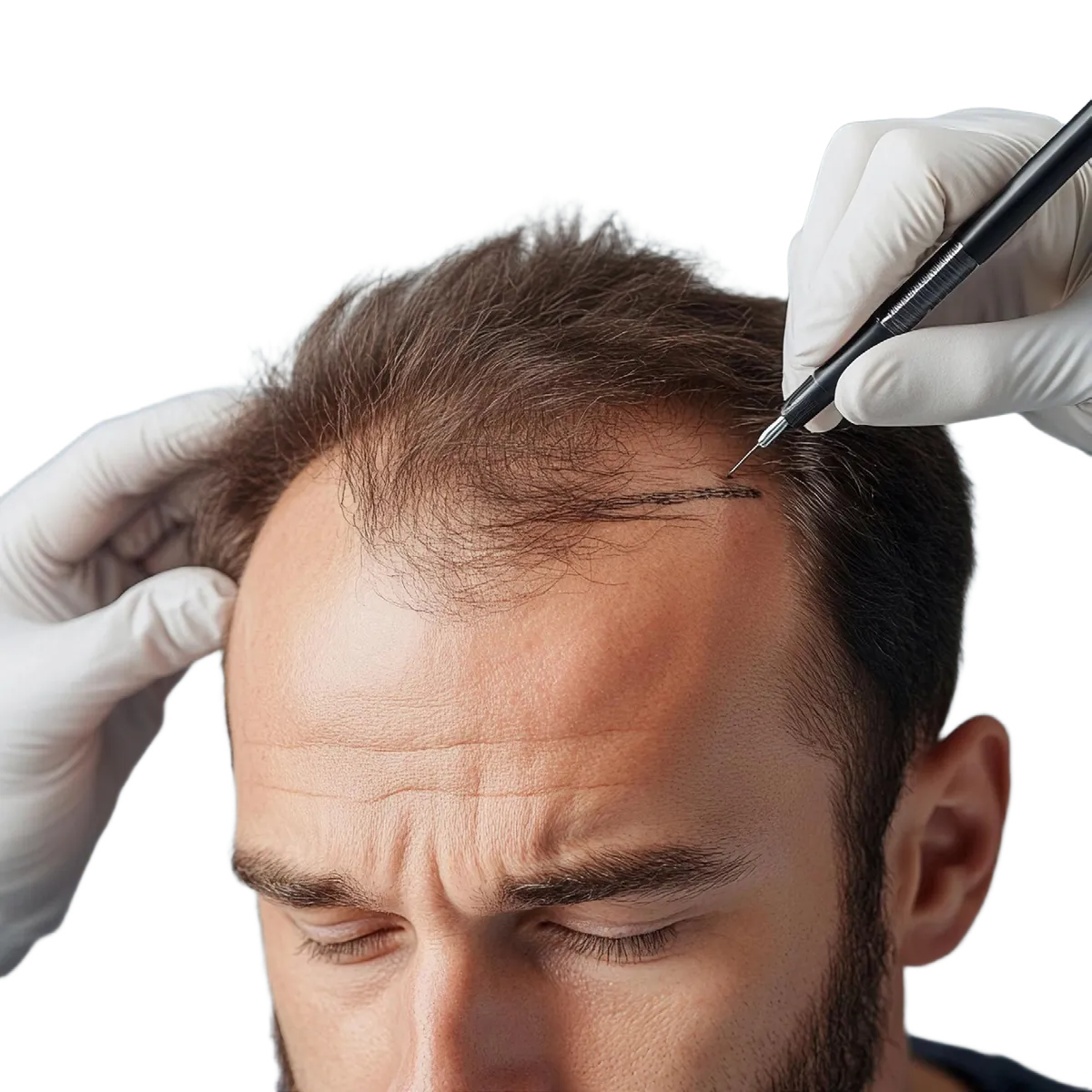
Direct Hair Implantation (DHI) places each follicle with a fine implanter pen at the exact angle, direction and depth of natural hair — for a hairline nobody can tell apart from your own.
Why DHI
- Minimally invasive: no scalpel incisions, no stitches and no linear scar.
- Precise: complete control over the depth, angle and direction of every graft as it is placed.
- Designed for graft survival: grafts are implanted soon after extraction, spending less time outside the body.
- Dense, natural placement: grafts can be placed between existing hairs, and the recipient area can often stay unshaven.
- Fast recovery: well suited to busy working professionals.
What DHI can do
- Hairline restoration and hairline lowering — rebuild a receding hairline or lower a high forehead.
- Crown fill — restore density to a thinning crown.
- Beard, moustache and eyebrow restoration — fill patchy areas with single-hair grafts.
How the procedure works
- Hair & scalp assessment: the doctor assesses your hair loss and donor area and estimates your grafts.
- Hairline design: your new hairline is drawn with millimetre precision and agreed with you.
- Local anaesthesia: you stay awake and comfortable throughout.
- Extraction: follicles are taken one by one from the back and sides of the scalp.
- Direct implantation: each graft is placed with the implanter pen at the natural angle and depth.
You go home the same day with a clear aftercare routine.
Recovery, day 1 to month 12
- Day 1–3: mild tenderness; sleep with your head slightly raised and follow the washing routine we give you.
- Day 7–14: tiny crusts clear and most people are back to normal routines.
- Week 2–8: most transplanted hairs shed. This is normal and expected — the roots stay in place and regrow.
- Month 3–4: new hair begins to grow.
- Month 6–8: visible density and texture.
- Month 12: the final, natural result.
Results vary from person to person and depend on your hair type, donor area and aftercare. Your expected result is explained at your scalp evaluation.